
The Complete Kitchen Remodeling Checklist for NJ Homeowners
Starting a kitchen remodeling project without a solid checklist is the fastest way to blow your budget and your timeline. This kitchen remodeling checklist walks you through every decision you need to make before the first wall comes down - from setting a realistic budget to pulling the right permits in New Jersey.
Whether you are updating a ranch home in Toms River or renovating a colonial in Freehold, the process involves the same core steps. Get them in the right order and you will avoid the most common and most expensive mistakes. If you are also weighing larger home improvement projects, our guide on planning a bathroom remodel covers the same phased approach for another high-ROI room.
Step 1: Set Your Budget Before Anything Else
Budget is the lens every other decision runs through. Start here, not with cabinet samples or countertop finishes.
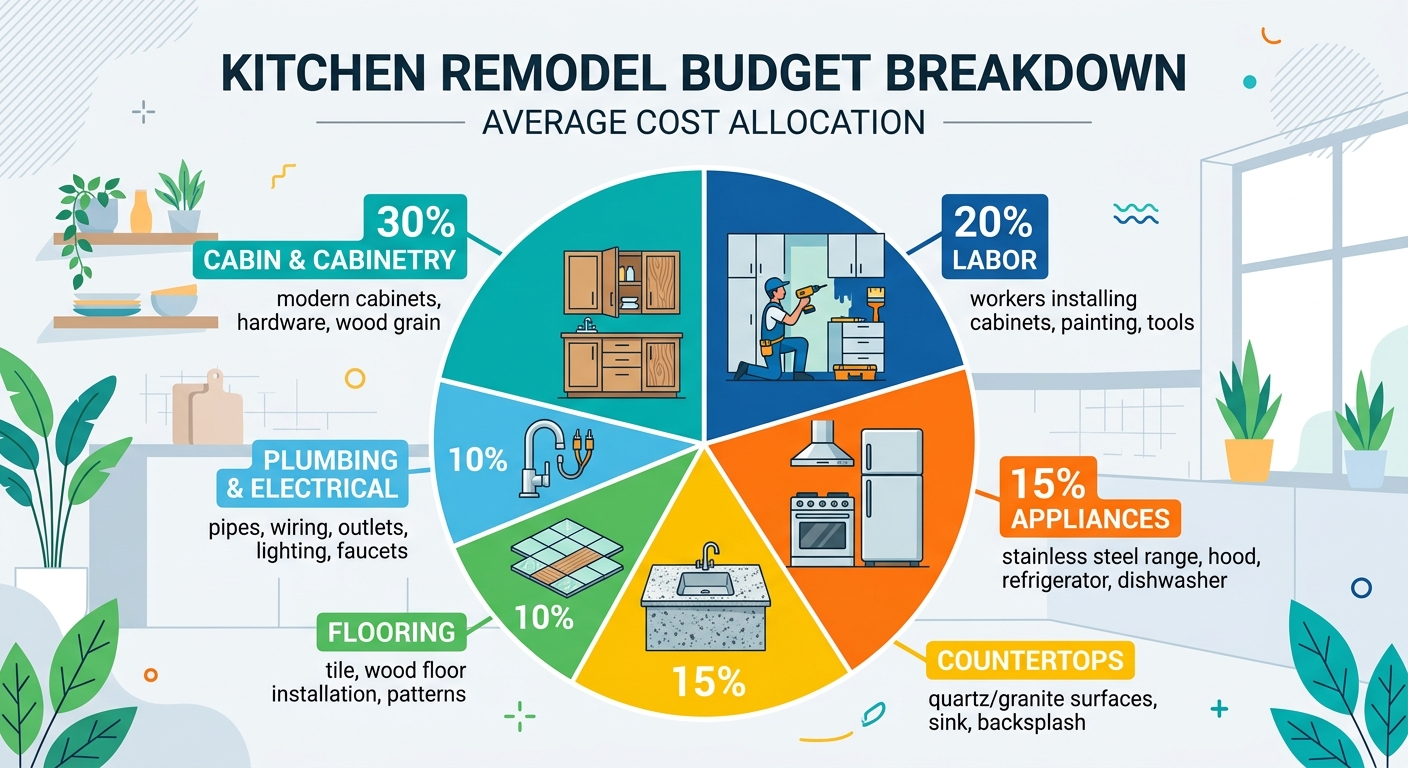
A mid-range kitchen remodel in New Jersey typically runs between $30,000 and $75,000 depending on square footage, layout changes, and finish level. High-end projects with custom cabinetry, stone counters, and appliance upgrades can exceed $150,000.
Budget Breakdown by Category
| Category | Typical % of Budget | Mid-Range Estimate |
|---|---|---|
| Cabinetry | 25-35% | $8,000-$25,000 |
| Labor | 20-30% | $7,000-$20,000 |
| Appliances | 15-20% | $5,000-$14,000 |
| Countertops | 10-15% | $3,500-$10,000 |
| Flooring | 7-10% | $2,500-$7,000 |
| Plumbing/Electrical | 5-10% | $2,000-$7,000 |
| Lighting/Hardware | 3-5% | $1,000-$3,500 |
| Contingency | 10-15% | Set aside before starting |
The contingency line is not optional. In older homes, which make up a large share of housing stock across Monmouth and Ocean County, opening walls almost always surfaces surprises: outdated wiring, old plumbing, or water damage. Budget for it before you find it.
Checklist: Budgeting
- Set total project budget including a 10-15% contingency
- Decide how much you are financing vs. paying out of pocket
- Research kitchen remodel ROI in your NJ market (typically 60-80% resale return)
- Get 3 itemized quotes before committing to a budget figure
- Identify which items you can source yourself (fixtures, hardware) to reduce contractor markup
Step 2: Know What Permits You Need in New Jersey
This is the step homeowners most often skip and most often regret. In New Jersey, kitchen remodeling work that involves structural changes, plumbing relocation, or electrical panel work requires permits from your local municipality.
Let Us Handle the Permits and the Work
Express Home Services - Licensed & Insured (HIC #13VH13950500)
📞 (609) 361-7686What Triggers a Permit in NJ
Under the New Jersey Uniform Construction Code (UCC), permits are generally required when work involves:
- Moving or adding electrical circuits
- Relocating plumbing supply lines or drain lines
- Removing or altering load-bearing walls
- Adding or enlarging windows or exterior doors
- Installing new mechanical ventilation (range hoods vented to exterior)
Cosmetic work like painting, replacing cabinet faces, swapping fixtures in the same location, and installing new flooring typically does not require a permit. But if your contractor is moving the sink or adding an island with a gas line, permits are required.
NJ Shore Area Considerations
Homes in FEMA flood zones, which are common throughout Ocean County towns like Ship Bottom, Beach Haven, Manahawkin, and Surf City, may face additional review requirements. If your property is in a special flood hazard area (SFHA) and the remodel cost exceeds 50% of the structure's pre-improvement market value, you may trigger substantial improvement rules under FEMA and local floodplain ordinances. Talk to your municipality's building department before finalizing scope.
Checklist: Permits
- Contact your local building department to confirm which work requires permits
- Verify your contractor pulls permits in your name (not just verbally promises to)
- Ask whether your property falls in a flood zone requiring additional review
- Budget time: permit approval in NJ typically takes 2-6 weeks depending on municipality
- Keep final inspection certificates once work is complete (required for home sale disclosure)
Step 3: Plan the Kitchen Remodeling Checklist Layout Phase
Layout decisions affect everything downstream: cabinetry sizing, appliance specs, plumbing rough-in locations, and electrical circuits. Lock this down before ordering anything.
The Work Triangle
The classic kitchen design principle centers the sink, refrigerator, and cooktop in a triangle. Each leg of the triangle should be between 4 and 9 feet, with the total perimeter between 13 and 26 feet. This is not a rigid rule, but it is a practical guide for functional kitchen flow.
Common layout options for NJ homes:
| Layout Type | Best For | Typical Footprint |
|---|---|---|
| L-Shape | Medium kitchens, open to dining | 150-250 sq ft |
| U-Shape | High-traffic, maximum storage | 175-300 sq ft |
| Galley | Narrow spaces, apartments | 100-175 sq ft |
| Island | Large kitchens, entertaining | 200+ sq ft |
| Peninsula | Smaller kitchens, partial open concept | 175-250 sq ft |
Checklist: Layout
- Decide whether you are keeping the existing layout or changing it (changing adds cost)
- Measure the room accurately: width, length, ceiling height, window and door positions
- Identify the locations of existing plumbing supply and drain lines
- Mark the locations of existing electrical panels, circuits, and outlets
- Plan for island clearance: minimum 42 inches for one cook, 48 inches for two
- Confirm appliance dimensions before ordering cabinets
Step 4: Select Your Materials
Material selection is where most budgets expand. The range between entry-level and high-end options is enormous. Set your priorities first, then shop within each category.
Cabinetry
Cabinets typically consume the largest share of the budget. Your main choices are:
- Stock cabinets: Pre-built in standard sizes. Lowest cost, 2-4 week lead time.
- Semi-custom: More size options and finish choices. 4-8 week lead time.
- Custom: Built to exact dimensions. Highest cost, 8-14 week lead time.
For NJ shore area homes, pay attention to finish durability. Kitchens near the coast deal with higher ambient humidity year-round. Plywood box construction holds up better than particleboard in humid environments. Frameless (European-style) cabinets with moisture-resistant finishes are worth the premium in coastal zip codes.
Countertops
| Material | Cost per Sq Ft (installed) | Durability | Maintenance |
|---|---|---|---|
| Laminate | $15-$40 | Moderate | Low |
| Butcher Block | $40-$100 | Moderate | Medium (oiling) |
| Quartz | $70-$150 | High | Low |
| Granite | $60-$140 | High | Low-Medium |
| Quartzite | $80-$200 | Very High | Low-Medium |
| Marble | $75-$250 | Moderate | High |
Quartz and granite are the most popular choices in the NJ remodeling market. Quartz is non-porous and more consistent in appearance. Granite is natural stone with unique variation. Both hold up well in busy kitchens.
Checklist: Materials
- Set material priorities: where to spend vs. where to save
- Order cabinetry first, as it has the longest lead time
- Confirm countertop fabrication timeline (typically 2-4 weeks after cabinet install)
- Select flooring that works with adjacent rooms for a cohesive transition
- Choose fixtures and hardware before finalizing countertop and cabinet colors (coordinate finishes)
- For shore area homes: specify moisture-resistant cabinet box construction
Step 5: Choose the Right Contractor for Your Kitchen Remodeling Project
The contractor you hire determines whether your project comes in on budget, on time, and up to code. Vetting takes time but it is the most important item on this kitchen remodeling checklist.
What to Verify
In New Jersey, home improvement contractors are required to be registered with the NJ Division of Consumer Affairs under the Home Improvement Contractor (HIC) program. Always ask for:
- NJ HIC registration number (verify at njconsumeraffairs.gov)
- General liability insurance certificate
- Workers' compensation certificate (if they have employees)
- References from completed kitchen projects in your county
Express Home Services holds HIC License #13VH13950500 and operates throughout Monmouth and Ocean County.
What to Ask Before Signing
- Who specifically will be on-site each day?
- Will you use subcontractors, and if so, are they licensed and insured?
- What is your payment schedule? (Never pay more than 10% down before work begins in NJ)
- How do you handle changes or unexpected conditions?
- What does your warranty cover and for how long?
Red Flags
- Wants full payment upfront
- Cannot provide an NJ HIC number
- Does not pull permits or suggests skipping them to save money
- No physical address or established business history
- Unusually low bid that is significantly below all other quotes
Checklist: Contractor Selection
- Get at least 3 written, itemized bids
- Verify NJ HIC registration for every contractor you consider
- Check NJ Consumer Affairs for complaints
- Ask for 2-3 kitchen-specific references and actually call them
- Review the contract for scope, payment schedule, change order process, and warranty
- Confirm they will pull all required permits
Get a Free Kitchen Remodeling Estimate - Monmouth and Ocean County
Express Home Services - Licensed & Insured (HIC #13VH13950500)
📞 (609) 361-7686Step 6: Build a Realistic Timeline
Kitchen remodels take longer than most homeowners expect. A mid-size project with layout changes, new cabinetry, and updated plumbing and electrical typically runs 8-14 weeks from contract signing to final walkthrough.
General Phase Timeline
| Phase | Typical Duration |
|---|---|
| Design and planning | 2-4 weeks |
| Permit application and approval | 2-6 weeks (runs concurrently) |
| Demolition | 2-5 days |
| Rough-in: plumbing, electrical, HVAC | 1-2 weeks |
| Inspections | 1-5 business days |
| Cabinet installation | 3-7 days |
| Countertop templating and fabrication | 2-4 weeks |
| Flooring installation | 2-5 days |
| Appliance installation | 1-2 days |
| Finish work: backsplash, fixtures, hardware | 1-2 weeks |
| Final inspection and punch list | 3-7 days |
Plan for the kitchen to be fully out of commission for at least 4-6 weeks during active construction. Set up a temporary kitchen in another room if possible.
Checklist: Timeline
- Agree on a project start date in writing
- Build permit approval time into your start date (do not assume permits are automatic)
- Order cabinets and long-lead materials at contract signing, not at demo day
- Schedule inspections as soon as rough-in work is complete
- Plan for temporary cooking and dishwashing arrangements
- Get a detailed schedule with milestones in writing before work begins
NJ-Specific Considerations for Kitchen Remodeling Projects
New Jersey homes have some characteristics that do not apply in other parts of the country. Any thorough kitchen remodeling checklist for NJ homeowners needs to address these directly.
Older Home Stock
A large percentage of homes in Ocean County and Monmouth County were built before 1980. Older homes commonly have:
- Knob-and-tube wiring (cannot be extended, must be replaced in renovated areas)
- Lead paint in pre-1978 homes (requires safe work practices and disclosure)
- Cast iron drain lines that may be corroding
- Plaster walls rather than drywall (heavier, harder to patch, may contain asbestos in very old homes)
- Smaller electrical panels (100 amp or less) that may need upgrading for modern kitchen loads
A good contractor will identify these conditions during the planning phase, not after demo starts. If you are undertaking a larger home renovation across multiple rooms, the same considerations apply - our article on building a custom home at the shore covers how to navigate older site conditions from the ground up.
Shore Area Humidity and Kitchen Remodeling Material Choices
Coastal towns from Point Pleasant down through Long Beach Island experience higher year-round relative humidity than inland communities. Kitchens in these areas face specific demands that an inland kitchen renovation checklist would not flag:
- Cabinet materials: Plywood box construction is mandatory near the shore. Particleboard swells with repeated humidity exposure within 3-5 years.
- Ventilation: A properly sized range hood vented to the exterior (not recirculating) is essential. Minimum 300 CFM for standard cooking, 600+ CFM for high-BTU ranges.
- Flooring choices: Engineered hardwood or tile holds up better than solid hardwood near the shore. Large-format porcelain tile (24x24 or larger) with minimal grout lines is the most practical choice.
- Grout and caulk selection: Use mold-resistant grout in all wet-area tile applications. Re-caulk countertop-to-backsplash joints every 3-5 years in humid coastal homes.
Electrical Capacity for Modern Kitchens
Modern kitchens run more circuits than older homes were designed to support. A well-equipped kitchen remodeling project typically requires:
- Dedicated 20-amp circuit for the refrigerator
- Dedicated 20-amp circuit for the dishwasher
- Two or more 20-amp small appliance circuits for counter outlets
- Dedicated circuit for the microwave (if over-the-range)
- Dedicated circuit for the range or cooktop (240V for electric)
If your home has a 100-amp panel, a kitchen renovation is often the trigger for a panel upgrade to 150 or 200 amps. Build this into your budget estimate - panel upgrades in NJ typically run $2,500-$5,000 depending on the work involved.
Common Kitchen Remodeling Checklist Mistakes to Avoid
Even experienced homeowners make avoidable errors on kitchen renovation projects. Here are the most common:
- Ordering materials before permits are approved: If your permit is denied or requires scope changes, materials ordered to spec may not work.
- Skipping the countertop template measurement: Countertops must be templated after cabinets are installed, not before. Ordering counters off a drawing leads to fitting problems.
- Underestimating lead times: Custom cabinets can take 10-14 weeks. If you order at contract signing, you may still be waiting when demo is done.
- Choosing finishes without seeing them in your actual kitchen lighting: Showroom lighting is designed to flatter every finish. Always bring samples home before committing.
- Not clarifying who cleans up each day: Kitchen renovation generates significant debris. Confirm the cleanup expectations in writing before work starts.
FAQ: Kitchen Remodeling in New Jersey
How long does a kitchen remodel take in NJ?
A basic cosmetic update can take 2-4 weeks. A full remodel with layout changes, new cabinetry, updated plumbing and electrical, and new countertops typically takes 8-14 weeks from start to finish. Permit approval timing is the biggest variable since municipalities process applications at different speeds. Starting the permit process as early as possible reduces overall project time.
Do I need a permit for a kitchen remodel in New Jersey?
It depends on what work is involved. Cosmetic updates like painting, replacing cabinet doors, or installing new flooring generally do not require a permit. Any work involving electrical circuits, plumbing relocation, structural changes, or new exterior ventilation does require a permit under the NJ Uniform Construction Code. Your contractor should advise on which work triggers permit requirements in your specific municipality.
What is the average cost of a kitchen remodel in NJ?
Mid-range kitchen remodels in New Jersey typically run $30,000 to $75,000. The wide range reflects differences in kitchen size, layout change complexity, finish level, and local labor rates. Shore area projects in Ocean County and Monmouth County often run toward the higher end of regional averages due to travel time and local market pricing. Get at least 3 itemized bids to calibrate your specific project.
How do I find a licensed kitchen remodeling contractor in NJ?
All home improvement contractors in New Jersey are required to be registered with the NJ Division of Consumer Affairs and carry an HIC (Home Improvement Contractor) registration number. You can verify any contractor's registration at njconsumeraffairs.gov. Also ask for general liability and workers' compensation certificates and check for complaint history before signing a contract.
What kitchen upgrades add the most value in NJ?
According to Remodeling Magazine's Cost vs. Value data, mid-range kitchen remodels recoup roughly 60-80% of their cost at resale in the Northeast. The highest-ROI upgrades tend to be cabinet refacing or replacement, countertop replacement, and new appliances. Layout changes and high-end custom finishes typically have lower ROI but higher owner satisfaction during occupancy. For resale-focused projects, prioritize function and neutral finishes over personal style choices.
How do I plan a kitchen remodel in a shore area home?
Shore area kitchens in towns like Ship Bottom, Barnegat, or Manahawkin face elevated humidity compared to inland NJ properties. Prioritize moisture-resistant cabinet construction (plywood box over particleboard), exterior-vented range hoods, and flooring materials rated for humid environments. Also confirm whether your property is in a FEMA flood zone, as remodels that exceed 50% of the structure's pre-improvement value can trigger additional floodplain compliance requirements.
Ready to Start Your Kitchen Remodeling Project?
This kitchen remodeling checklist covers the major decisions and steps, but every project has details that only surface once you are walking the space with a contractor. The best next step is a free in-home estimate where you can talk through your specific layout, budget, and goals.
Express Home Services serves Monmouth and Ocean County homeowners with licensed kitchen remodeling services. We hold NJ HIC License #13VH13950500 and pull all required permits. For homeowners considering a whole-home renovation, see our spring roof maintenance guide and roof repair vs. replacement breakdown - two common projects that often come up alongside interior remodels.
Call us at (609) 361-7686 to schedule your estimate. We work throughout the shore area and inland communities of both counties.