
Spring Roof Maintenance Tips for New Jersey Homeowners
Spring roof maintenance is one of the most cost-effective things an NJ homeowner can do each year. After a New Jersey winter - with its freeze-thaw cycles, heavy snow loads, ice dams, and nor'easters - your roof has taken real stress. Spring is the right time to assess what winter left behind before the heat of summer and the next storm season arrive.
The good news is that a meaningful portion of spring roof maintenance can be done by the homeowner from the ground and from the attic. You do not need to be on the roof to catch the most important warning signs early.
This guide walks through the full spring roof maintenance checklist: gutter cleaning, shingle inspection, flashing, attic ventilation, and moss and algae prevention. We also cover what to hand off to a licensed contractor versus what you can handle yourself.
Why Spring Is the Right Time for Spring Roof Maintenance in NJ
New Jersey winters create specific damage patterns that are best caught in early spring, before spring rains compound any existing problems.
What winter does to NJ roofs:
- Ice dams form when heat escapes through the roof, melts snow at the ridge, and the meltwater refreezes at the cold eaves. The ice backs up under shingles and forces water into the roof assembly.
- Freeze-thaw cycling works water into any existing crack or gap. Water expands when it freezes, widening cracks that were otherwise manageable.
- Heavy snow loads stress flat or low-slope sections and can compress or crack shingles near valleys.
- Wind-driven sleet and freezing rain wears down the granule layer and can loosen flashing.
Spring also brings NJ's peak rainfall season. Ocean County and Monmouth County typically see their heaviest rain months from March through May. If your roof has any winter damage, those spring rains will find it. Catching problems in early March or April is far better than discovering a ceiling stain in June.
Gutter Cleaning and Inspection: Step One of Spring Roof Maintenance
Gutters are the first line of defense for your roof's edge and your home's foundation. Clogged gutters cause water to back up under the drip edge and shingles, leading to fascia rot, soffit damage, and eventually interior water intrusion.
After winter, gutters in Ocean County and Monmouth County are commonly full of:
- Decomposed leaves and organic debris that washed in over fall and winter
- Shingle granules (dark, sand-like material) from aging shingles
- Ice dam residue and sediment
- Debris from nearby trees - twigs, seed pods, pine needles
Gutter cleaning steps:
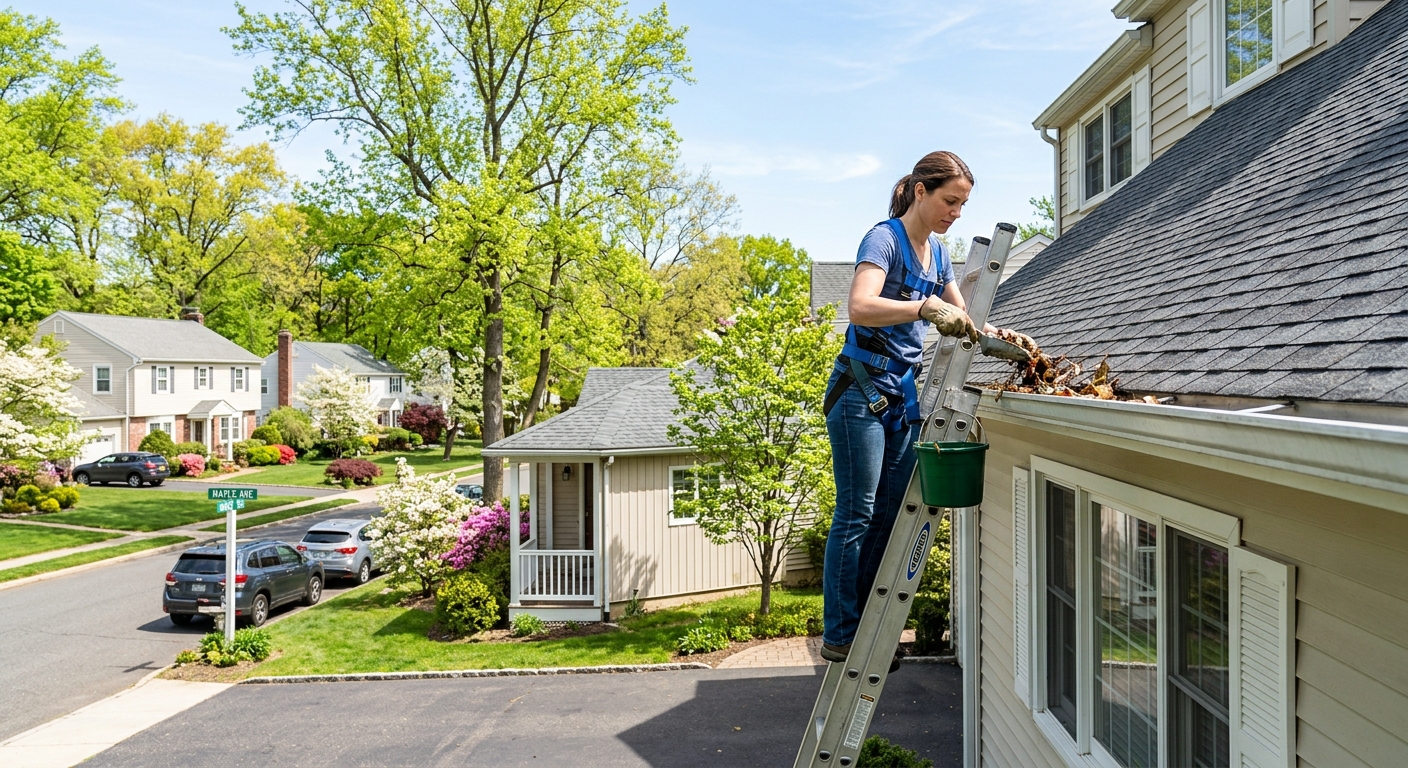
- Use a stable ladder positioned at the downspout first - check whether the downspout is draining freely before cleaning the rest of the run
- Remove debris by hand or with a gutter scoop, working away from the downspout
- Flush each gutter section with a garden hose toward the downspout
- Watch for standing water after flushing - gutters should drain completely and not hold water in any section
- Check that downspouts discharge at least 4 to 6 feet from the foundation
While cleaning, inspect the gutters themselves. Look for:
- Separations at the seams or at the connection to the fascia
- Sections that have pulled away from the fascia board
- Visible rust spots or holes in the gutter channel
- Fascia boards that look soft, discolored, or have paint peeling - this often means water has been backing up behind the gutter
Schedule Your Spring Roof Inspection Before Storm Season Hits.
Express Home Services - Licensed & Insured (HIC #13VH13950500)
📞 (609) 361-7686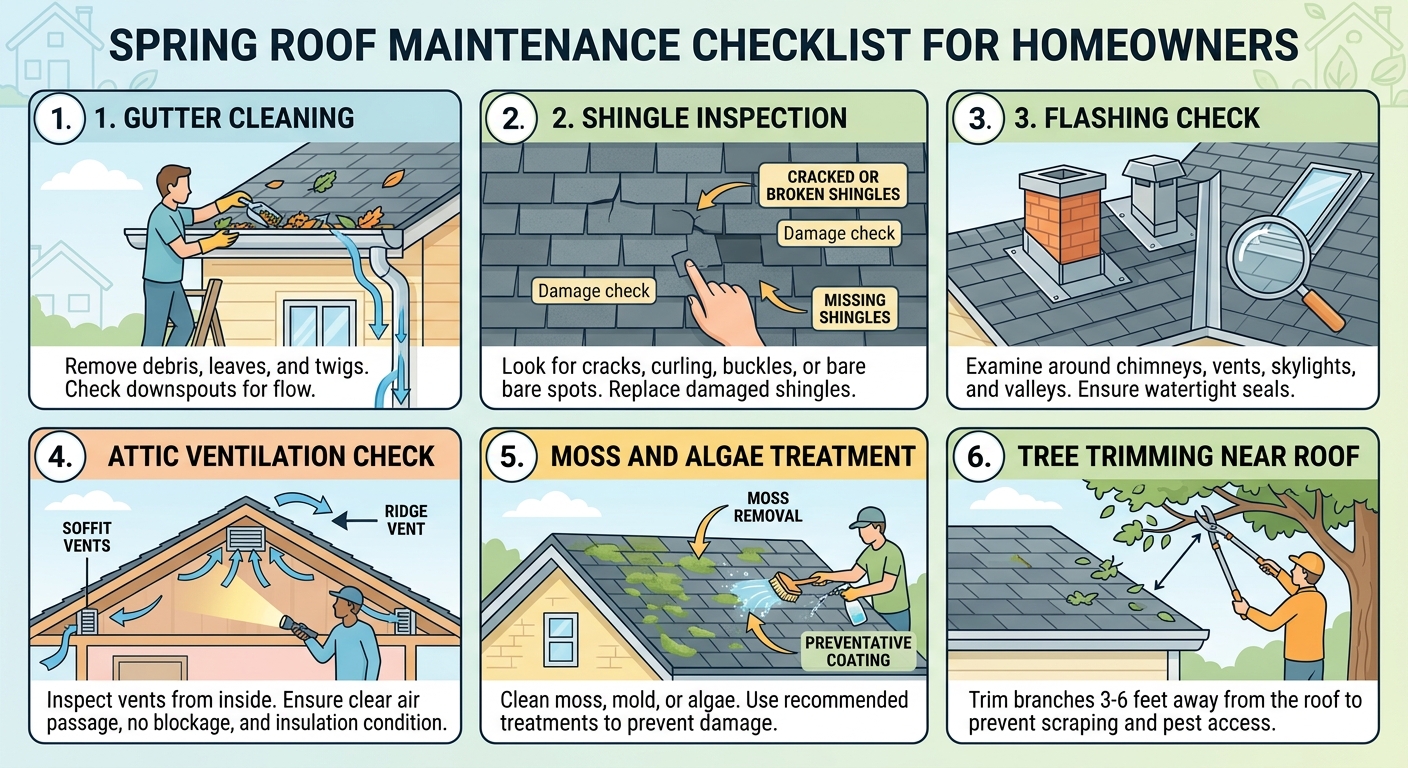
Shingle Inspection: What to Look For From the Ground
You do not need to be on your roof to conduct a meaningful shingle inspection. A pair of binoculars and a walk around the perimeter of your home will reveal most significant issues.
Common Post-Winter Shingle Problems
Ice dam damage: Ice dams form at the eaves and can physically lift shingles. Look for shingles near the lower edge of the roof that appear raised, curled upward, or have obvious creases from being forced up by ice. The damage is often most visible on north-facing roof sections that receive less sun and hold ice longer.
Cracked shingles: Winter cold makes asphalt shingles brittle. Wind events during cold weather can crack shingles cleanly rather than lifting them. Look for shingles with straight or jagged breaks running across the surface.
Missing shingles: Note any bare sections of the roof deck and their approximate location. Document with photos.
Granule accumulation in gutters: If you found a large volume of dark granules when cleaning gutters, note it. Some granule loss is normal - significant accumulation after a single winter season is a warning sign. Consistent granule loss year over year is one of the key signs your roof may need replacement.
What to document:
- Photograph any visible damage from the ground
- Note which side of the roof the damage is on (helps a contractor prioritize)
- Note the approximate age of the roof if you know it
What Requires a Contractor's Eyes
A ground-level inspection has real limits. The following warrant a professional on-roof assessment:
- Any area where you found active water infiltration in the attic during winter
- Roofs over 15 years old, where shingle brittleness means damage that is not visible from the ground may still be present
- Roofs with low-pitch sections (under a 4:12 pitch) where water sits longer and penetrates more aggressively
- Homes near the shore in Ocean County, where salt air accelerates shingle degradation in ways that are not always visible externally
Flashing Inspection: The Most Overlooked Maintenance Task
Flashing is the sheet metal - typically galvanized steel or aluminum - installed at roof intersections, around penetrations, and at transitions between the roof and vertical surfaces like chimneys or dormers. It is the most common source of roof leaks, and it gets almost no attention during typical homeowner inspections.
Locations to inspect:
- Chimney flashing: Step flashing (the small L-shaped pieces that step up the sides of a chimney) and counter flashing (the piece embedded in the mortar joints that laps over the step flashing). Both can separate over time as the chimney and roof settle at different rates.
- Valley flashing: Metal or woven shingle valleys at the V-shaped intersections where two roof planes meet
- Vent pipe boots: The rubber or lead collar around plumbing vent pipes. Rubber boots crack with UV exposure and age; lead boots can develop pinhole corrosion.
- Skylight flashing: Skylights have both a head flashing (at the top) and step flashing on the sides - both are leak-prone
- Dormer flashing: Where dormer walls meet the main roof, water channels directly at the flashing joint
Signs of flashing failure:
- Visible gaps or separation between the flashing and the adjacent surface
- Rust streaks on the roof surface running away from a flashing joint
- Lifted or bent metal that has separated from the surface it was sealing against
- Cracked or deteriorated caulk at flashing terminations
- Water stains on interior surfaces directly below a flashing location
Most flashing problems are repairable without a full roof replacement. Catching them in spring, before heavy rains test them, is the goal.
Attic Ventilation Check
Attic ventilation is directly connected to roof longevity and is a critical part of spring roof maintenance. A poorly ventilated attic causes two specific problems:
- Heat buildup in summer: Attic temperatures in an under-ventilated NJ home can exceed 150 degrees Fahrenheit on hot days. That sustained heat accelerates shingle aging and can warp the roof deck over time.
- Moisture buildup in winter: Warm, moist interior air that rises into a cold attic can condense on the underside of the roof deck. Over time, this condensation can cause mold, rot the decking, and degrade insulation.
Proper ventilation means a balanced system: intake at the soffits (low on the roof), exhaust at the ridge or upper roof. Air should flow in at the bottom and out at the top continuously.
What to check in spring:
- Are soffit vents clear of insulation? Walk the attic perimeter and look at the soffit area. Batts or blown-in insulation commonly migrate to cover soffit vents, blocking intake airflow.
- Is there a ridge vent, and does it appear unobstructed from the outside?
- Do you see any evidence of condensation damage on the underside of the roof deck - dark staining, mold spots, or soft/deteriorated wood?
- Does the attic smell musty? Persistent moisture has a distinct smell that is easy to recognize.
Ventilation Standards to Know
The general industry guideline is 1 square foot of net free ventilation area per 150 square feet of attic floor space, split equally between intake and exhaust. A licensed contractor can assess whether your current ventilation meets this standard and what changes, if any, would improve roof performance.
Moss, Algae, and Organic Growth Prevention
Moss and algae are more than cosmetic problems on NJ roofs. Moss retains moisture against the shingle surface and can work under shingle edges, accelerating granule loss and causing premature aging. Algae (the black or dark green streaks common on shaded roof sections) is less structurally damaging but indicates persistent moisture conditions that are worth addressing.
New Jersey's humidity and rainfall make organic growth a common issue, particularly on north-facing roof sections and in areas shaded by mature trees.
Treating Existing Growth
For light to moderate moss or algae growth:
- A 50/50 mix of water and household bleach applied with a low-pressure sprayer is an effective treatment for algae. Let it dwell and rinse with low-pressure water.
- Purpose-made roof cleaning solutions (oxygen-based) are a less corrosive alternative and are safer around landscaping
- Do NOT use a pressure washer on asphalt shingles - the high pressure strips granules and shortens shingle life significantly
For significant moss growth with physical lifting of shingle edges, professional cleaning followed by a moss inhibitor treatment is the appropriate approach.
Preventing Future Growth
- Keep trees trimmed back from the roof - debris and shade both promote growth
- Install zinc or copper strips along the ridge: rainwater washes trace metal ions down the roof surface and inhibits biological growth
- Improve attic ventilation to reduce the moisture conditions that favor moss and algae
Spring Roof Maintenance Checklist
Use this checklist each spring after winter weather has passed:
| Task | DIY or Pro | Urgency if Issues Found |
|---|---|---|
| Clean gutters and flush downspouts | DIY | High - address within 2-4 weeks |
| Inspect gutters for separation and sagging | DIY | High |
| Shingle inspection from ground level | DIY | Moderate to High depending on findings |
| Flashing visual inspection from ground | DIY | High - flashing failures cause leaks quickly |
| Attic inspection for water stains and daylight | DIY | High |
| Check soffit vents are clear of insulation | DIY | Moderate |
| Inspect for moss, algae, or organic growth | DIY | Moderate |
| On-roof professional inspection | Licensed Contractor | Recommended annually for roofs 10+ years |
| Flashing repair or re-sealing | Licensed Contractor | As needed based on inspection |
| Ventilation assessment | Licensed Contractor | If attic condensation found |
When to Call a Professional for Your Spring Roof Maintenance
Some spring roof maintenance tasks are straightforward DIY. Others warrant a licensed contractor.
Call a pro when:
- Your attic inspection revealed water stains, active moisture, or daylight through the deck
- You found flashing separations or visible gaps at any penetration or chimney
- Your ground-level inspection showed cracked, lifted, or missing shingles
- Your roof is 15 or more years old and you have not had a professional inspection in the past 2 to 3 years
- You are preparing to sell your home - a documented professional inspection is a useful disclosure item
- You want documentation suitable for an insurance record or a future claim
A professional spring inspection on a roof over 15 years old can catch developing problems when they are still minor repairs, not major replacements. That is typically a significant cost difference. If the inspection turns up extensive damage from this past winter, it may be worth reviewing how to identify storm damage before calling your insurance company.
| Roof Condition | Recommended Action | Professional Inspection Frequency |
|---|---|---|
| Under 5 years, no issues | DIY maintenance tasks only | Every 3-5 years |
| 5-10 years, no issues | DIY tasks + gutter inspection | Every 2-3 years |
| 10-15 years, minor wear | DIY tasks + pro inspection | Annually |
| 15-20 years, visible wear | Pro inspection + targeted repairs | Annually, before storm season |
| 20+ years | Pro inspection, plan for replacement | Annually, plan ahead |
Get Your Spring Inspection Done Right - Before Summer Storm Season.
Express Home Services - Licensed & Insured (HIC #13VH13950500)
📞 (609) 361-7686Frequently Asked Questions About Spring Roof Maintenance
How often should I clean my gutters in New Jersey?
Most NJ homes benefit from at least two cleanings per year - once in late fall after leaves have dropped, and once in early spring after winter debris has accumulated. Homes with many surrounding trees, or in areas with heavy pine needle drop, may need a third cleaning in early summer. Clear gutters prevent water backup at the eave, which is one of the most common causes of interior water damage in NJ homes.
Is spring roof maintenance really necessary if my roof looks fine from the yard?
Yes, because a ground-level visual check misses a lot. Ice dam damage, flashing separations, and early granule loss are often not apparent from 40 feet away at a steep angle. The attic inspection - which any homeowner can do - is a more reliable check than a yard-level look. Water stains in the attic show up before ceiling stains appear, meaning you catch problems earlier and at lower repair cost.
What does spring roof maintenance cost if I hire a contractor?
A professional spring roof inspection typically costs between $150 and $400 depending on roof size and complexity. Many roofing contractors in Ocean County and Monmouth County offer free inspections, particularly if you are interested in getting a quote for any repair work identified. Minor flashing repairs and re-caulking typically run a few hundred dollars. Gutter cleaning services in NJ commonly range from $100 to $300 depending on linear footage.
Can I walk on my own roof to inspect it?
Walking on a roof without proper equipment, footwear, and training is not recommended for most homeowners. Wet roofs are slippery. Older roofs may have soft spots in the decking that can give way. If you do go up, use proper fall protection, wear soft-soled shoes, and avoid walking on dry-rotted shingles. For most homeowners, a ground-level inspection combined with a thorough attic check covers the most important bases safely.
What is an ice dam and what damage does it leave behind?
An ice dam is a ridge of ice that forms at the edge of a roof when warm air escaping through the roof melts snow near the ridge, and the meltwater runs down and refreezes at the cold eave overhang. As ice accumulates, it creates a dam that traps meltwater behind it. That water backs up under the shingles and can infiltrate the roof assembly. The damage ice dams leave behind includes lifted shingles at the eaves, water stains in the attic and on ceilings, rotted fascia, and - in severe cases - damaged wall framing. The proper fix addresses both the symptom (ventilation and insulation improvements) and any resulting damage.
Does spring maintenance extend the life of my roof?
Yes, meaningfully so. Keeping gutters clear prevents water backup that accelerates eave deterioration. Catching minor flashing failures before they become active leaks prevents deck rot. Addressing moss growth before it lifts shingle edges extends shingle life. Proper attic ventilation reduces heat-related shingle aging. None of these are dramatic single-event improvements, but together they can extend a well-maintained roof's functional life by several years compared to one that receives no maintenance attention. If your roof is already showing wear, review the signs that point toward replacement to know whether maintenance is still the right play.
What Spring Roof Maintenance Costs in Ocean County and Monmouth County
Spring roof maintenance ranges from free (DIY tasks you can do yourself) to a few hundred dollars for professional inspection and minor repairs. Here is a realistic cost breakdown for NJ homeowners:
| Task | Typical Cost | Notes |
|---|---|---|
| DIY gutter cleaning | $0 (your time) | Ladder and gutter scoop required |
| Professional gutter cleaning | $100-$300 | Depends on linear footage |
| Professional spring roof inspection | $0-$400 | Many NJ contractors offer free inspections |
| Flashing re-sealing (minor) | $150-$400 | Single penetration or chimney |
| Vent pipe boot replacement | $200-$450 per boot | Common spring repair after winter freeze-thaw |
| Moss treatment (professional) | $300-$800 | Includes inhibitor application |
| Minor shingle repair | $300-$700 | Up to 10 shingles |
The cost of catching a flashing failure in spring is a few hundred dollars. The cost of ignoring it until it causes water damage to framing and insulation is several thousand. Spring roof maintenance is not an optional expense for NJ homeowners - it is the maintenance that prevents the expensive repairs.
When Spring Maintenance Turns Into a Replacement Conversation
A spring inspection sometimes reveals that the cumulative damage from prior winters puts the roof past the repair threshold. Signs that point toward replacement include widespread granule loss, multiple soft spots in the deck, and curling shingles across more than one section. If your spring inspection produces these findings, review the full list of warning signs that a roof needs replacement and consider whether you are maintaining a roof or simply delaying an inevitable replacement.
Schedule Your Spring Roof Inspection With Express Home Services
Express Home Services serves homeowners throughout Monmouth County and Ocean County, NJ with spring roof maintenance inspections, repairs, and full replacements. We are HIC licensed (#13VH13950500) and have worked on homes across Ship Bottom, Toms River, Brick, Barnegat Light, Manahawkin, Long Branch, Red Bank, and the surrounding communities.
Spring is the best time to catch what winter left behind. A professional spring roof maintenance inspection is a small investment that prevents much larger repair bills later in the year.
Call (609) 361-7686 today to schedule your spring roof maintenance inspection. We provide written assessments with no pressure and no obligation.