
Roof Repair vs. Replacement: How to Decide in New Jersey
The roof repair vs. replacement decision is one of the most expensive calls a homeowner makes. Get it wrong in one direction and you spend thousands patching a roof that needed to come off. Get it wrong in the other direction and you pay for a full replacement when targeted repairs would have added years of service life.
This guide is written specifically for New Jersey homeowners, with attention to the coastal weather conditions, nor'easters, and salt air exposure that accelerate roof wear throughout Monmouth and Ocean County. Before you make this call, it also helps to know the warning signs your roof is aging out - some of those indicators will shift your decision significantly.
How Roof Repair and Replacement Differ
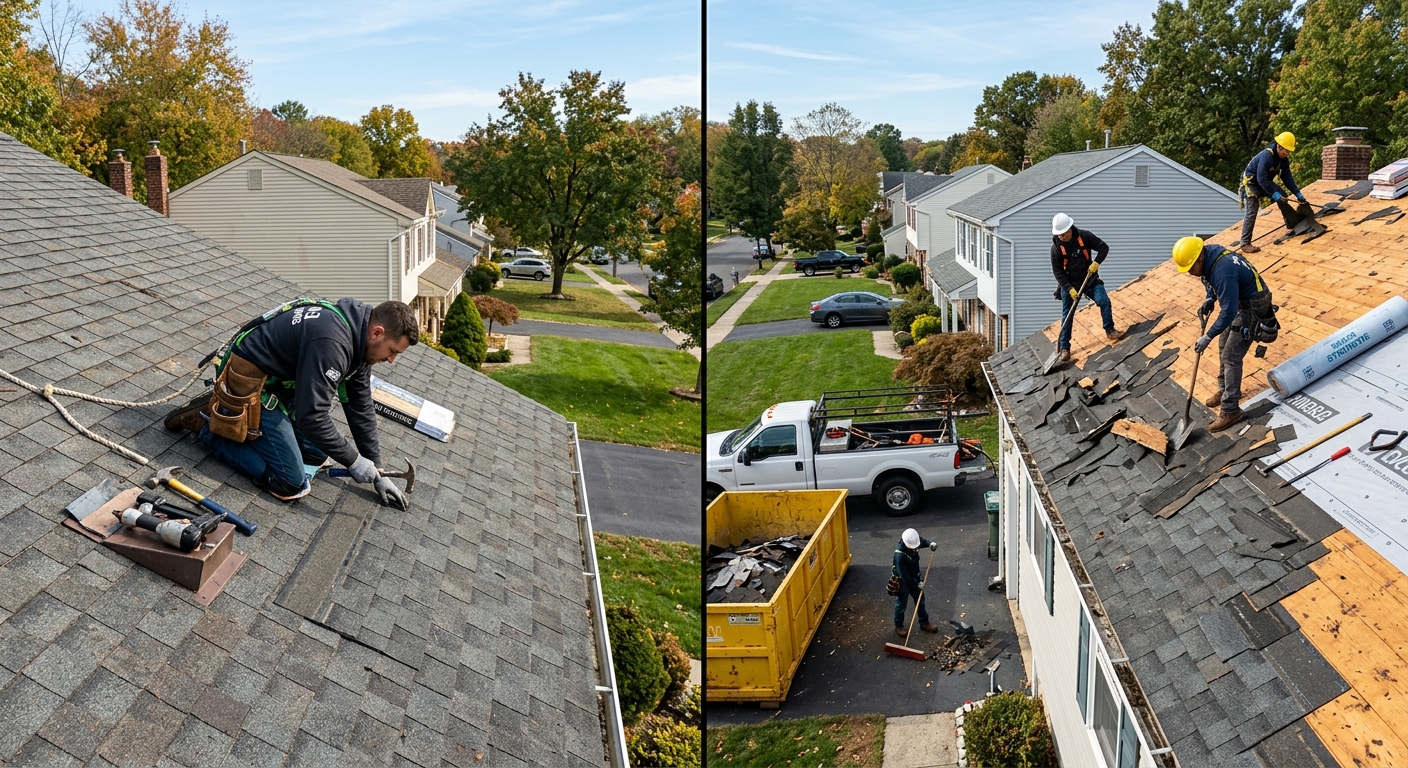
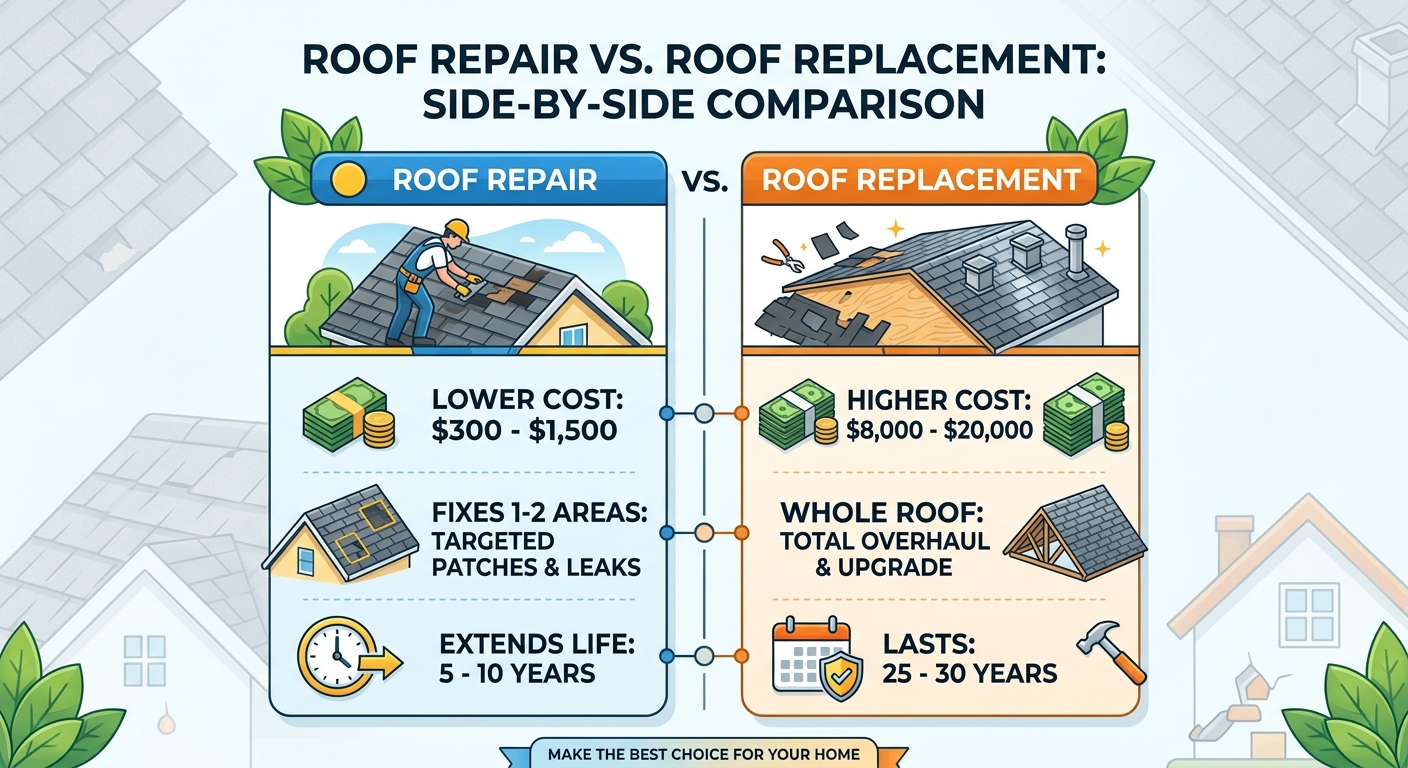
Roof repair addresses damage in a specific area: replacing missing shingles, sealing a flashing leak, patching wind damage around a chimney or vent. The rest of the roof stays in place.
Roof replacement removes all existing roofing material down to the deck, inspects and repairs the decking as needed, and installs a complete new roofing system. In New Jersey, most residential roofs use asphalt shingles, though metal roofing and synthetic materials are growing in the shore market.
The roof repair vs. replacement decision is rarely obvious from the ground. A professional inspection is the right starting point for any roof with visible damage or recurring leaks. That said, knowing the factors that influence the repair vs. replacement call helps you have a more informed conversation with your contractor.
The Age of Your Roof
Roof age is the single most useful filter. A 5-year-old roof with storm damage almost always warrants repair. A 22-year-old roof with the same damage warrants a harder look at replacement.
Get a Free Roof Inspection in Monmouth or Ocean County
Express Home Services - Licensed & Insured (HIC #13VH13950500)
📞 (609) 361-7686Expected Lifespan by Material
| Roofing Material | Expected Lifespan | Shore Area Adjustment |
|---|---|---|
| 3-tab asphalt shingles | 15-20 years | Subtract 3-5 years |
| Architectural (dimensional) shingles | 25-30 years | Subtract 3-5 years |
| Metal roofing (steel/aluminum) | 40-70 years | Minimal adjustment |
| Synthetic slate/shake | 40-50 years | Minimal adjustment |
| Cedar shake | 20-30 years | Subtract 5+ years |
The shore area adjustment reflects accelerated wear from salt air, higher UV exposure, and the coastal storm cycle. Homes within a few miles of the ocean in towns like Ship Bottom, Seaside Heights, or Manasquan tend to see shorter effective service lives from asphalt products.
Age-Based Rules of Thumb
A commonly used industry guideline: if the roof is within 80% of its expected lifespan, replacement is worth comparing to repair even for minor damage. On a 25-year architectural shingle roof in an inland NJ town, that threshold falls around year 20. In a coastal zip code with accelerated wear, the effective threshold may be closer to year 16 or 17.
Extent and Type of Damage
Age tells you one part of the story. Damage extent tells the other. If you are assessing your roof after a storm, our guide to identifying roof storm damage walks through the specific things to look for from the ground and in the attic.
When Repair Makes Sense
Repair is typically the right call when:
- Damage is limited to a specific area (one slope, one section near a penetration)
- The underlying deck is sound with no soft spots or delamination
- The rest of the shingles show normal, even wear
- The roof is in the first half of its expected lifespan
- You are dealing with flashing failure rather than shingle failure
Common repairable conditions include:
- Missing shingles from a wind event
- Flashing leaks around chimneys, skylights, or vents
- Isolated granule loss from impact (hail, falling debris)
- Pipe boot collar failure
- Valley repair after storm damage
When Replacement Makes More Sense
Replacement is worth serious consideration when:
- More than 25-30% of the roof surface shows significant wear or damage
- Multiple leaks are occurring in different areas
- Shingles are curling, cupping, or cracking across a broad area
- Granule loss is widespread (check gutters after rain, heavy granule runoff means aging shingles)
- The decking has water damage in multiple areas
- You are doing a major home renovation and the roof is approaching end of life
The 50% Rule
A practical guideline: if repairing the damage would cost more than 50% of a full replacement, replace. Patching a roof that is broadly failing delays the inevitable and adds cost without adding years. You will often spend 60-70% of replacement cost in repairs over 2-3 years before replacing anyway.
Cost Comparison: Repair vs. Replacement in NJ
Costs vary based on roof size, pitch, material, and contractor. These ranges reflect typical pricing in Monmouth and Ocean County as of early 2026.
Repair Cost Ranges
| Repair Type | Typical Cost Range (NJ) |
|---|---|
| Missing shingles (up to 10) | $300-$700 |
| Flashing repair (chimney or skylight) | $400-$1,200 |
| Valley repair | $500-$1,500 |
| Pipe boot replacement (per boot) | $200-$450 |
| Partial section repair (1 slope) | $1,500-$4,500 |
| Emergency tarping | $400-$1,000 |
Replacement Cost Ranges
| Roof Size | 3-Tab Shingles | Architectural Shingles | Metal Roofing |
|---|---|---|---|
| 1,500 sq ft (15 squares) | $7,500-$11,000 | $10,000-$16,000 | $18,000-$28,000 |
| 2,000 sq ft (20 squares) | $9,500-$14,000 | $13,000-$20,000 | $24,000-$36,000 |
| 2,500 sq ft (25 squares) | $12,000-$17,500 | $16,000-$25,000 | $30,000-$45,000 |
| 3,000 sq ft (30 squares) | $14,000-$21,000 | $19,000-$30,000 | $36,000-$54,000 |
These are installed costs including labor, materials, tear-off, and disposal. Steep pitches, multiple penetrations, and difficult access (common in older shore bungalows on narrow lots) add to labor cost.
NJ-Specific Factors: Coastal Weather and Nor'easters
New Jersey's coastal climate is harder on roofs than most parts of the country. Understanding why helps explain both why damage occurs and why some repair-vs-replace thresholds are different here than in inland markets.
Salt Air Degradation
Salt air is corrosive. Metal components on the roof, including flashings, drip edge, and fasteners, corrode faster in coastal zones. Asphalt shingles also show faster granule release in high-salt environments. If your home is within roughly 5 miles of the ocean, the effective lifespan of standard roofing materials is shorter than manufacturer warranties might suggest.
For homes in Long Beach Island, the Barnegat Bay towns (Toms River, Brick, Barnegat, Forked River), and the northern Ocean County and southern Monmouth County shore communities, this is a real factor in material selection. Aluminum flashings over galvanized steel, synthetic underlayments over felt, and impact-rated shingles all represent meaningful upgrades in the coastal NJ market.
Nor'easters
Nor'easters are the dominant storm type for roof damage in New Jersey. Unlike summer thunderstorms that produce localized damage, nor'easters can deliver sustained winds of 40-60 mph with gusts over 75 mph over a period of hours, combined with heavy rain or wet snow loading.
Sustained wind events are harder on roofs than short-duration peaks. They find every weakness in sealing, flashing, and fastener patterns. Homes that have had multiple nor'easter events without a full inspection may have accumulated damage that is not yet leaking but is actively compromising the roof system.
After any significant nor'easter, a professional inspection is warranted if your roof is more than 10 years old. Visible damage from the ground (missing shingles, lifted ridge cap) is just the starting point.
Freeze-Thaw Cycles
New Jersey gets enough winter temperature swings to produce damaging freeze-thaw cycles. Water that works its way under shingles or into cracked flashings expands when it freezes and widens any existing gaps. This is how small, ignored repairs become major leaks over 1-2 winters.
Coastal NJ Roofing - Get an Expert Opinion Before the Next Storm Season
Express Home Services - Licensed & Insured (HIC #13VH13950500)
📞 (609) 361-7686Insurance Considerations for NJ Homeowners
Insurance is often a key factor in the repair vs. replacement decision, and the rules are not always intuitive.
What Insurance Typically Covers
Homeowner's insurance generally covers roof damage from sudden, accidental events: wind, hail, fire, or falling debris. It does not cover damage from normal wear and aging. This distinction matters because:
- A nor'easter that blows off shingles on a 15-year-old roof may be a covered claim
- The same roof with significant granule loss from age is not covered, even if it is leaking
- Insurers may pay for repair when the damage is localized, even if you prefer full replacement
Age-Adjusted Settlements
Many NJ homeowners discover that their insurer applies depreciation to older roofs. If your 20-year-old roof is damaged, the insurer may value it at 30-40% of replacement cost and offer a reduced settlement. Review your policy for Actual Cash Value (ACV) vs. Replacement Cost Value (RCV) coverage. RCV coverage pays the full replacement cost minus your deductible. ACV coverage pays the depreciated value.
Working with Your Adjuster
When filing a roof claim:
- Document everything before any emergency repairs (photos, video)
- Get a contractor inspection report in writing before the adjuster visit
- Understand that the adjuster works for the insurance company, not for you
- You have the right to bring in a public adjuster or an attorney if you dispute the settlement
- Never sign over your claim to a contractor (assignment of benefits) without understanding the implications
The ROI Question: Does Replacement Pay Off?
For homeowners who plan to sell within 5-7 years, roof condition is a transactional issue. A roof that is near end of life or has visible deferred maintenance will show up on the buyer's inspection, trigger price negotiations, or kill deals.
A new roof typically adds 60-70% of its cost back in resale value according to Remodeling Magazine's Cost vs. Value data for the Northeast. More importantly, it removes a line item from the buyer's inspection report that can result in far larger price reductions than the actual roof cost.
If you are staying in the home for 15+ years, the ROI math shifts. You get the full service life of the new roof, you eliminate emergency repair costs and interior damage from leaks, and you have the option to upgrade to better materials (impact-rated shingles, metal roofing) that reduce long-term maintenance. Keeping the roof in good shape is also part of seasonal home maintenance that protects your investment year over year.
Common Roof Repair vs. Replacement Scenarios in NJ
These real-world situations come up regularly in Ocean County and Monmouth County. Each one illustrates how the roof repair vs. replacement calculation plays out in practice.
Scenario 1: Storm Damage on a 12-Year-Old Roof
A nor'easter removes a section of shingles from one slope. The roof is 12 years old with architectural shingles. The deck is dry. The rest of the roof looks uniform and granule loss is minor.
Verdict: Repair. The roof is in the first half of its expected lifespan. Damage is localized. This is exactly what repair is designed for. Match the shingle color as closely as possible - if it has been discontinued, ask your contractor about blending techniques to minimize the visual mismatch.
Scenario 2: Granule Loss and Curling on a 19-Year-Old Coastal Roof
The gutters are full of granules after every storm. Several sections near the ridge show clawing. The roof is 19 years old and within 3 miles of the coast.
Verdict: Replacement. The granule loss and curling indicate the shingles have aged past functional performance. At 19 years in a coastal zip code, you are past the effective service life for standard asphalt shingles. Repairs would be patching material that is failing across the board.
Scenario 3: Single Flashing Leak Around a Skylight
Water shows up on the ceiling near a skylight after heavy rain. The roof is 8 years old and in good overall condition. The contractor identifies failed flashing, not shingle failure.
Verdict: Repair. Flashing failure is not a sign of overall roof aging. This is a discrete repair at a specific penetration. The cost is typically $400-$1,200 and the fix extends the life of an otherwise sound roof for years.
Scenario 4: Visible Sagging on a 22-Year-Old Roof
The roofline has a visible dip along one section. The attic shows soft decking in that area and multiple water stains from prior winters.
Verdict: Replacement with deck repair. Structural issues combined with an aged roof and cumulative water damage make this a full replacement candidate. The scope needs to include deck repair before new shingles go down.
| Scenario | Roof Age | Damage Type | Roof Repair vs. Replacement Verdict |
|---|---|---|---|
| Storm damage, localized | Under 15 years | Wind/hail | Repair |
| Widespread granule loss | 15+ years | Age-related | Replacement |
| Single flashing failure | Any | Penetration leak | Repair |
| Sagging + water damage | 18+ years | Structural + water | Replacement + deck work |
| Multiple leaks after prior repairs | Any | Recurring failure | Investigate root cause, likely replace |
FAQ: Roof Repair vs. Replacement in New Jersey
How do I know if my roof needs repair or replacement?
The key variables are age, damage extent, and deck condition. If the roof is within the first half of its expected lifespan and damage is localized, repair is usually appropriate. If the roof is approaching end of life, damage is widespread, or the deck shows water damage in multiple areas, replacement is worth a serious look. A professional inspection is the most reliable way to assess deck condition, which is not visible from outside.
How long do roofs last in coastal New Jersey?
Standard 3-tab asphalt shingles typically last 15-20 years in inland NJ, but closer to 12-17 years in shore area communities due to salt air and coastal storm exposure. Architectural (dimensional) shingles last 25-30 years inland and 20-25 years near the coast. Metal roofing holds up much better in coastal environments and can last 40-70 years with minimal maintenance.
What causes roof damage in NJ nor'easters?
Nor'easters cause roof damage through sustained high winds, wind-driven rain, and wet snow loading. Sustained winds are more damaging than short wind gusts because they work under lifted shingles and flashing for extended periods. Common nor'easter damage includes lifted or missing shingles, flashing separation, damaged ridge caps, and gutter damage. After a significant nor'easter, inspect from the ground and schedule a professional inspection if your roof is more than 10 years old.
Will insurance cover a full roof replacement in New Jersey?
It depends on the cause of damage, your policy type, and your roof's age. Insurance covers sudden, accidental damage from wind, hail, and similar events. It does not cover normal aging. Policies with Replacement Cost Value (RCV) coverage pay full replacement cost minus your deductible. Policies with Actual Cash Value (ACV) coverage apply depreciation, which can result in a much smaller payout on an older roof. Read your policy before filing a claim.
What roofing material is best for shore area homes in NJ?
For homes within a few miles of the ocean in Ocean County and Monmouth County, architectural shingles rated for high winds (Class H or Class 4 impact rating) are a significant upgrade over standard 3-tab. Metal roofing (standing seam aluminum or steel with a quality coating system) is the best performer in salt air environments if the budget allows. Avoid low-grade galvanized fasteners and flashings; specify aluminum or stainless in coastal applications.
How much does a roof replacement cost in Ocean County or Monmouth County NJ?
For a typical 2,000 square foot home, expect $13,000-$20,000 for architectural shingles and $24,000-$36,000 for metal roofing in the current NJ market. Prices vary based on pitch, number of penetrations, tear-off layer count (NJ allows a second layer before full tear-off is required), and access conditions. Get at least 3 itemized bids and verify that every contractor carries NJ HIC registration and adequate insurance.
Making the Call: A Quick Decision Framework
Before picking up the phone, run through these questions:
- How old is the roof, and what is its expected lifespan in your specific location?
- Is the damage localized or distributed across multiple areas?
- Is the deck sound, or are there soft spots, rot, or water staining?
- What will the repairs cost vs. what a full replacement would cost?
- Is the home going on the market within 5 years?
- Was the damage event-related or the result of normal aging?
If you answer three or more questions in ways that point toward replacement, get a replacement quote. If most answers point toward repair, get a repair quote and ask the contractor to give you an honest assessment of the roof's remaining life.
Talk to a Licensed NJ Roofing Contractor
The roof repair vs. replacement decision starts with a professional inspection. Express Home Services works throughout Monmouth and Ocean County, including shore communities from Long Beach Island to the Raritan Bayshore.
We hold NJ HIC License #13VH13950500 and provide written inspection reports and detailed estimates. There is no pressure and no obligation.
Call (609) 361-7686 to schedule your inspection.