
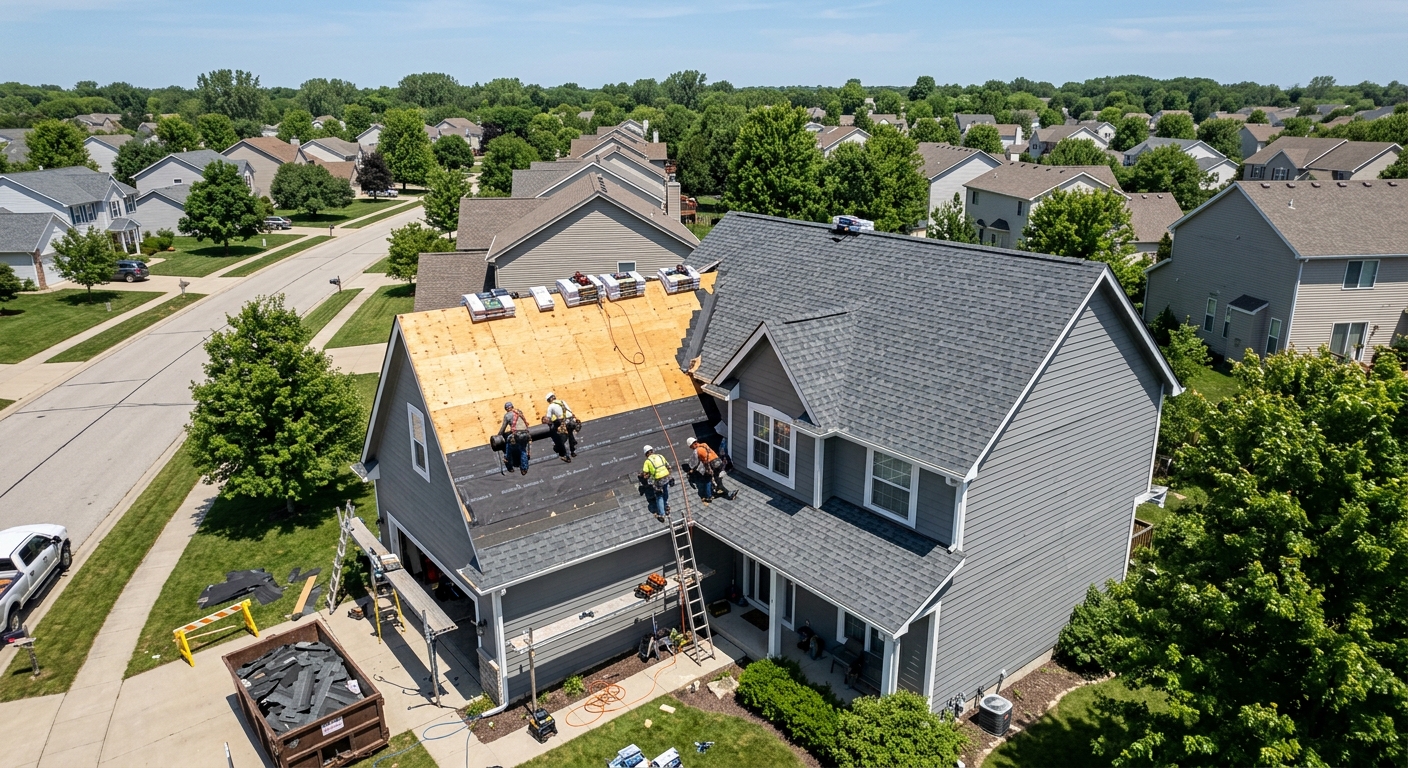
Roof Replacement Cost in 2026: What NJ Homeowners Should Expect to Pay
Roof replacement cost in New Jersey typically runs between $9,500 and $54,000 depending on the size of the home, roofing material, and site conditions. Most homeowners in Monmouth and Ocean County pay somewhere in the $13,000 to $25,000 range for a standard architectural shingle replacement on a 1,500 to 2,500 square foot home.
That is a wide range, and the gap is real. Roof replacement cost is driven by a specific set of variables, and understanding them lets you budget accurately, evaluate contractor bids, and avoid paying more than the job is worth.
This guide breaks down pricing by material, roof size, and the NJ-specific factors that tend to push costs up in coastal markets. If you are still weighing whether replacement is even necessary, the roof repair vs. replacement guide covers that decision in detail.
What Drives Roof Replacement Cost
Roof replacement cost is not simply square footage times a material price. The final number is a combination of materials, labor, disposal, permits, and site-specific conditions. Here are the main variables.
Roof size (squares). Roofing is priced per square, where one square equals 100 square feet of roof surface. A 2,000 square foot house typically has a roof surface of 22 to 28 squares, depending on pitch and complexity. More squares mean more material and more labor hours.
Roofing material. The gap between a 3-tab asphalt shingle and a standing seam metal roof is substantial. Material cost alone can account for 40 to 60 percent of the total project price.
Pitch (steepness). Steeper roofs require additional safety equipment, slower installation pace, and more labor hours. Anything above a 6:12 pitch typically carries a pitch surcharge. Many older shore bungalows in communities like Lavallette, Ship Bottom, or Seaside Heights have lower-pitched roofs that are easier to work on, while custom homes in Monmouth County often have steep, complex rooflines.
Number of layers being removed. NJ building code allows up to two layers of asphalt shingles before a full tear-off is required. If your roof already has two layers, tear-off adds material weight, dumpster cost, and significant labor time. Expect tear-off of double-layer roofs to add $1,500 to $3,000 on a typical residential job.
Deck condition. A standard replacement price assumes the decking is sound. Rotted or damaged sheathing is replaced as discovered and billed at a per-sheet rate, typically $75 to $150 per sheet of plywood or OSB installed. On homes that have had chronic leaks or deferred maintenance, deck repair costs can add meaningfully to the total.
Penetrations and complexity. Every chimney, skylight, vent, dormer, or valley adds flashing work and slows installation. A simple gable roof with no penetrations costs less per square than a complex hip roof with three dormers and a skylight.
Access conditions. Tight lot lines, landscaping, and limited staging space all affect labor efficiency. Shore communities with narrow lots and close neighbors often present access challenges that inland suburban jobs do not.
Disposal and permits. Dumpster rental, disposal fees, and the NJ building permit add to every project. Permits for roof replacement in NJ run $50 to $300 depending on municipality, and disposal fees have risen in recent years.
Get an Accurate Roof Replacement Estimate for Your NJ Home
Express Home Services - Licensed & Insured
📞 (609) 361-7686Roof Replacement Cost by Material
Material selection is the single biggest lever on total project cost. Here is how the main options compare for NJ residential roofing as of 2026.
| Roofing Material | Installed Cost per Square | Notes |
|---|---|---|
| 3-tab asphalt shingles | $350-$550/sq | Entry-level; 15-20 yr lifespan inland |
| Architectural (dimensional) shingles | $500-$800/sq | Most common NJ residential choice |
| Impact-rated architectural shingles | $600-$950/sq | Recommended for coastal zones |
| Standing seam metal (steel) | $900-$1,400/sq | 40-70 yr lifespan; strong in salt air |
| Standing seam metal (aluminum) | $1,100-$1,600/sq | Best corrosion resistance for shore homes |
| Synthetic slate/shake | $750-$1,200/sq | Good durability, premium appearance |
| Cedar shake | $700-$1,100/sq | Shorter lifespan in coastal NJ; higher maintenance |
These are all-in installed costs including labor, tear-off of a single layer, underlayment, flashing, and disposal. Multi-layer tear-off, deck repair, and complex geometry are additional.
Asphalt Shingles
Architectural (dimensional) shingles are the standard choice for most NJ residential roofs. They offer a meaningful durability upgrade over 3-tab for a modest cost increase, and most major manufacturers offer 30-year limited warranties. In coastal areas, specifying shingles with a Class H wind rating (or the newer ASTM D3161 Class F classification) is worth the modest premium.
3-tab shingles are still installed, but they have largely fallen out of favor among contractors because the long-term cost calculus rarely works in the homeowner's favor. You save $1,500 to $3,000 upfront on a typical job but lose 5 to 10 years of service life.
Metal Roofing
Metal roofing has grown in the coastal NJ market, particularly on Long Beach Island, the barrier island communities, and waterfront properties in Ocean and Monmouth County. The premium over asphalt is real, typically 80 to 120 percent more on a per-square basis, but the durability argument in a salt air environment is strong.
Steel roofing requires a quality paint system (Kynar or similar PVDF coating) to resist corrosion. For homes within a mile or two of the ocean, aluminum is often the better long-term choice despite the higher upfront cost, because aluminum does not rust.
Synthetic Slate and Shake
Synthetic roofing products have improved substantially. High-quality synthetic slate and shake products offer Class 4 impact ratings, 40 to 50 year lifespans, and are not subject to the cracking and maintenance issues of natural cedar in the freeze-thaw cycle. They cost more than architectural shingles but less than metal, and they carry better appearance warranties than most asphalt products.
Roof Replacement Cost by Roof Size
The table below shows estimated total installed costs in the current NJ market. Prices assume architectural shingles with single-layer tear-off, standard pitch (4:12 to 6:12), and no significant deck repair.
| Roof Size | Approx. Squares | Architectural Shingles | Impact-Rated Shingles | Metal Roofing (Steel) |
|---|---|---|---|---|
| 1,200 sq ft home | 14-16 sq | $8,000-$13,000 | $9,500-$15,000 | $15,000-$24,000 |
| 1,500 sq ft home | 17-21 sq | $10,000-$16,000 | $12,000-$19,000 | $18,000-$28,000 |
| 2,000 sq ft home | 22-28 sq | $13,000-$22,000 | $15,000-$26,000 | $24,000-$38,000 |
| 2,500 sq ft home | 27-34 sq | $16,000-$27,000 | $19,000-$32,000 | $30,000-$48,000 |
| 3,000 sq ft home | 33-41 sq | $20,000-$33,000 | $23,000-$39,000 | $36,000-$57,000 |
The roof surface area is always larger than the home's footprint because of pitch. A 2,000 square foot single-story home with a 6:12 pitch will have roughly 25 to 28 squares of roof surface.
Note: these are estimates for planning purposes. Actual costs depend on the specific variables outlined above. Complex rooflines, steep pitch, double-layer tear-off, and deck repairs can push a project 20 to 40 percent above these ranges. Get itemized bids to understand your specific job.
NJ-Specific Cost Factors
Roof replacement cost in New Jersey runs above national averages for a handful of reasons that are specific to this market.
Coastal Weather and Material Upgrades
Homes in Ocean County's barrier island communities, the Barnegat Bay shoreline (Toms River, Brick, Forked River, Barnegat), and the Monmouth County shore communities face accelerated wear from salt air. Standard contractor-grade materials that would perform adequately in an inland market often underperform in these environments.
Specifying materials appropriate to the coastal environment typically adds $500 to $2,000 to a project. That cost is almost always recovered in extended service life, particularly on metal roofing.
Labor Rates
New Jersey labor rates for skilled roofing crews are among the higher rates in the Northeast. The NJ contractor licensing requirement (Home Improvement Contractor registration under NJDCA) adds a compliance cost compared to unlicensed states. Labor typically accounts for 40 to 55 percent of a roofing project in this market.
Avoid bids from crews that cannot provide their NJ HIC registration number. Hiring an unregistered contractor creates liability exposure for the homeowner and voids any permit-based warranty on the work.
Disposal Fees
NJ landfill tipping fees have risen over the past several years. Asphalt shingle disposal costs have followed. On a typical 20 to 25 square job, disposal runs $600 to $1,200. Double-layer tear-offs generate roughly twice the debris and cost more to dispose of.
Permits
Most NJ municipalities require a building permit for roof replacement. Some homeowners try to avoid this cost, but permitted roofs carry proper inspection records, which matter when selling the home or filing an insurance claim. Permit cost is a legitimate line item in every compliant bid.
Wind and Impact Upgrades
Given the coastal storm exposure in this market, most experienced NJ roofing contractors will recommend wind-rated installation methods (6-nail pattern instead of 4-nail, sealed starter strips, specific flashing methods for coastal exposure). These add modest labor cost but significantly improve storm performance. After a major nor'easter, the difference between a standard installation and a wind-rated installation becomes very visible.
Understanding when a roof has reached the end of its service life is related to this cost question. If you are seeing early warning signs of aging, the signs your roof needs replacement guide covers the specific indicators to watch for.
Financing Options for Roof Replacement
A $15,000 to $25,000 roof replacement is a significant expense for most homeowners. Several financing options are commonly available.
Home equity line of credit (HELOC). For homeowners with equity, a HELOC typically offers the lowest interest rate of any financing option. Draw what you need, pay interest only during the draw period. The interest may be tax-deductible if used for home improvement (consult a tax advisor).
Home equity loan. Fixed rate, fixed term, lump sum disbursed at closing. Predictable payments. Good option if you want rate certainty.
Contractor financing. Many contractors offer financing through third-party lenders (GreenSky, EnerBank, Hearth, and similar). Terms range from 12 months same-as-cash to 10-year installment loans. Interest rates vary widely; compare to your other options before accepting.
Personal loan. Unsecured, faster to obtain than home equity products. Interest rates are higher, but approval can happen in days. Suitable for homeowners without significant equity.
Insurance claim proceeds. If the replacement is driven by storm damage, your homeowner's insurance may cover a portion. See the insurance section below.
Cash. Paying cash sometimes creates room to negotiate on price, particularly in slower seasons (late fall, winter). Contractors price jobs partly around the risk of payment delays; a cash buyer reduces that risk.
Insurance and Roof Replacement Cost
Insurance can significantly change the out-of-pocket cost of a roof replacement, or it can be irrelevant, depending on the cause of the damage and the type of policy you hold.
What Insurance Covers
Homeowner's insurance typically covers sudden, accidental damage: wind, hail, fire, fallen trees. It does not cover normal aging or gradual deterioration. If a nor'easter removes half your shingles, that is a covered event. If your 22-year-old shingles are failing from age, that is not.
RCV vs. ACV Policies
This distinction matters more than most homeowners realize. Replacement Cost Value (RCV) policies pay the full cost of replacing the roof with comparable materials, minus your deductible. Actual Cash Value (ACV) policies pay the depreciated value of the roof, which can be dramatically less on an older roof.
On a 20-year-old roof with a $15,000 replacement cost, an ACV policy might pay out $4,000 to $6,000 after depreciation. An RCV policy would pay $15,000 minus your deductible. Check your policy declarations page.
Filing a Claim
If you suspect storm damage, have a contractor inspect before the insurance adjuster visits. A written contractor assessment gives you documentation that supports your claim. The adjuster works for the insurance company. Having your own documentation matters.
If the damage occurred recently and you have not filed, get a professional inspection. Some storm damage is not immediately visible from the ground. Our guide to identifying roof storm damage covers what to look for after a weather event.
How to Evaluate Roofing Bids in NJ
Getting multiple bids is standard advice. Getting multiple itemized bids is more useful. Here is what to look for.
A complete roofing bid should include:
- Total squares being replaced
- Material manufacturer and specific product name (not just "architectural shingles")
- Underlayment specification
- Number of layers being removed
- Flashing scope (new flashing at all penetrations vs. reuse existing)
- Deck repair allowance or per-sheet price
- Permit cost (or explicit exclusion)
- Dumpster and disposal cost
- Warranty terms for both material and labor
- Contractor's NJ HIC license number and insurance certificates
A bid that does not specify the product or the scope of tear-off cannot be compared accurately to one that does. Low bids often reflect cut corners on underlayment quality, flashing replacement, or disposal.
Verify every contractor's NJ HIC registration at the NJDCA website before signing anything. Unlicensed contractors are a real risk in the home improvement market, and NJ has consumer protection statutes that only apply to contracts with registered contractors.
FAQ: Roof Replacement Cost in New Jersey
How much does a roof replacement cost in NJ in 2026?
For a typical 1,500 to 2,500 square foot home in Monmouth or Ocean County, expect $10,000 to $27,000 for architectural shingles and $18,000 to $48,000 for metal roofing as of 2026. The range is wide because pitch, tear-off layers, deck condition, and material quality all significantly affect the final number. Get itemized bids from at least three licensed NJ contractors for an accurate estimate on your specific home.
How long does a roof replacement take?
Most residential roof replacements in NJ take one to three days for the installation itself. Scheduling lead time is typically two to six weeks depending on the contractor's backlog and the time of year. Spring and early fall are the busiest periods. Obtaining the building permit can add a few days to a week on the front end. Weather delays are common; contractors will generally reschedule if conditions are unsafe.
Is it cheaper to repair or replace a roof?
In the short term, repair is almost always cheaper. Over a multi-year horizon, it depends heavily on the roof's age and condition. Repeated repairs on a roof approaching end of life often cost more cumulatively than a single replacement, and they do not stop the underlying aging process. The roof repair vs. replacement guide covers this decision in detail with NJ-specific cost comparisons.
What roof replacement cost should I budget for a shore home in NJ?
Shore homes often carry higher costs than inland homes for a few reasons: coastal material upgrades (impact-rated shingles or aluminum metal roofing), access challenges on narrow lots, and the higher labor rates common in barrier island and waterfront communities. Budget at the higher end of the ranges in this guide for homes in communities like Long Beach Island, Mantoloking, Bay Head, or any property close to the water.
Will a new roof increase my home's value?
A new roof typically returns 60 to 70 percent of its cost in added resale value according to industry cost vs. value data for the Northeast. The more significant benefit in many cases is what it prevents: a failing roof triggers buyer inspection concerns, price negotiations, and sometimes deal-killing repair credits. A new roof removes that line item entirely and signals well-maintained property.
Can I finance a roof replacement in NJ?
Yes. Common options include HELOCs, home equity loans, unsecured personal loans, and contractor-arranged financing through third-party lenders. Contractor financing is convenient but not always the lowest rate. If you have home equity and time to apply, a HELOC typically offers the best rate. If you need funding quickly, personal loans through online lenders close in days. Compare rates before committing to any financing option.
How do I know if my roof replacement quote is reasonable?
Compare at least three itemized bids from licensed NJ contractors. Verify that each bid specifies the material product, tear-off scope, underlayment type, flashing replacement, permit cost, and disposal cost. Bids that are significantly below others often reflect thinner margins on materials or labor costs that will show up later as callbacks. Verify each contractor's NJ HIC registration number before signing.
Get an Accurate Roof Replacement Estimate
Roof replacement cost varies enough that online calculators and national averages will not give you an accurate budget for your specific home. The only reliable way to know what your replacement will cost is a site visit from a licensed NJ roofing contractor.
Express Home Services serves homeowners throughout Monmouth and Ocean County, including shore communities from Long Beach Island north through the Bayshore. We hold NJ HIC License #13VH13950500 and provide detailed written estimates at no charge.
Call (609) 361-7686 to schedule your estimate.